So, you've started a landscaping business.
You've got the van, the tools, the experience and probably a pair of work boots that have seen better days. You've told your friends and family, set up a Facebook page and spent an alarming amount of time deciding what shade of green your logo should be.
There's just one small problem.
The phone isn't ringing.
And here's the thing about running a landscaping business: you can be absolutely brilliant at transforming gardens, laying patios or building decking, but if nobody knows you exist, your beautifully organised collection of power tools is going to spend rather a lot of time in the garage.
Marketing for landscapers doesn't need to be complicated. You don't need a degree in digital marketing, a £5,000 advertising budget or someone dancing in front of a camera explaining why your business needs to go viral.
You need a plan.
So, in this guide, I'm going to take you through a practical 90-day marketing plan designed specifically for UK landscaping businesses. We'll cover what to do first, where to find your early customers, how to build your reputation and when it might actually make sense to spend some money on advertising.
There's also a free downloadable checklist to help you work through everything.
Key points
- Start by identifying the landscaping services, customers and locations you actually want to target.
- Get your Google Business Profile and website in place before spending heavily on advertising.
- Use referrals, local relationships and genuine examples of your work to find your first customers.
- Turn every completed project into an opportunity to generate future enquiries.
- Track enquiries, quotations, jobs won and profitability, not just website traffic and social media likes.
- Test paid marketing gradually and only increase your spending when the results justify it.
- Use our free 90-day landscaping marketing checklist to keep yourself on track.
Before you start: What sort of landscaping business are you building?
Before we get anywhere near Facebook adverts, websites or Google rankings, there's an important question to answer.
What sort of work do you actually want?
It sounds obvious, but plenty of new businesses make the mistake of trying to be everything to everyone.
They offer garden maintenance, fencing, decking, patios, driveways, garden design, tree surgery, pressure washing and, if you catch them on a quiet Tuesday, probably a bit of gutter cleaning.
There's nothing wrong with offering several services if you've got the skills and capacity to deliver them properly. But from a marketing perspective, trying to promote everything at once can make it difficult for customers to understand what you're particularly good at.
A garden maintenance business looking for regular weekly customers needs a different marketing approach from a landscaper who wants to win £15,000 garden transformations.
One wants a reliable route of customers close to home. The other wants a smaller number of higher-value projects.
Start with three simple decisions
1. Which services do you want to promote?
Choose two or three services that you're good at, enjoy delivering and can price profitably.
For example, patios and paving, fencing and decking, or complete garden transformations.
2. Where do you want to work?
Choose a realistic service area. If you're based in Worcester, you probably don't need to market yourself as covering the entirety of England, Wales and parts of northern France.
Travelling two hours each way for a small job rarely makes good commercial sense.
3. Who is your ideal customer?
Are you targeting homeowners who want regular garden maintenance, families planning a garden transformation, property developers, landlords or commercial businesses?
The clearer you are about who you want to attract, the easier it becomes to decide what to put on your website, which photographs to share and where to spend your marketing budget.
90-day action plan
Your 90-day marketing plan
- Days 1–14Build your foundations
Website, Google Business Profile, contact details and priority services.
- Days 15–30Find your first customers
Local referrals, community groups, complementary trades and outreach.
- Days 31–60Build trust and visibility
Reviews, project case studies, photographs and local SEO.
- Days 61–90Improve and repeat
Measure results, follow up quotes and test marketing channels.
90 days is an action plan, not a guarantee of marketing results.
Days 1–14: Build your marketing foundations
The first two weeks are about getting the basics right.
I know this isn't the most exciting part of starting a business. You'd probably rather be operating a mini digger than spending an afternoon setting up online profiles.
But there's little point in attracting potential customers if, when they look you up, they can't find your business or work out how to contact you.
Set up your Google Business Profile
If you only do one thing from this article today, make it this.
A Google Business Profile is a free business listing that can help your landscaping company appear in Google Search and Google Maps when people look for services in their local area.
Think about how a homeowner might search for a landscaper.
They might type:
- Landscapers near me.
- Patio installers in Cheltenham.
- Garden landscaping Bristol.
- Fencing contractors near me.
These are the sorts of searches where you want your business to be visible.
To get started, visit Google Business Profile and create or claim your business listing.
Make sure you:
- Use your actual business name.
- Choose the most relevant available business category.
- Add the areas you genuinely serve.
- Enter accurate contact details and opening hours.
- Add information about your services.
- Complete Google's verification process.
- Upload genuine photographs that represent your business.
One important point for landscapers working from home: if customers don't visit your premises and you travel to them instead, Google generally requires you to hide your address and operate as a service-area business.
Don't invent an office address in every town you'd quite like to rank in. Google has rules about that, and spending your Friday afternoon trying to get a suspended profile reinstated is not an enjoyable hobby.
Read Google's official Business Profile guidelines.
Get a professional landscaping website
Yes, I know. I'm a co-founder of a company that builds websites for tradespeople, so you may be thinking I would say that.
Fair enough.
But here's why I think a website should be one of the foundations of your marketing.
Imagine a homeowner receives a recommendation for your business from a neighbour. They're interested in having a new patio installed, so they search for your company.
What do they find?
A Facebook page that hasn't been updated since last summer? Three photographs of a fence? A mobile number and a business name that could belong to anyone?
Or do they find a professional website that explains what you do, shows examples of your work, tells them where you operate and makes it easy to request a quotation?
Which of those businesses would you feel more comfortable contacting?
Your website doesn't need to be enormous.
For a new landscaping business, it could start with a clear homepage, information about your main services, a little about your experience and an easy way for customers to get in touch.
As you complete more projects, you can add dedicated service pages, project galleries, case studies and genuine customer reviews.
And the best thing of all? It's ridiculously affordable.
Starting at just £29 + VAT per month, you can have an experienced team of web designers, developers and digital marketers building you a professional, premium-quality website that's designed specifically for your landscaping business.
No hefty upfront design fees. No evenings spent trying to work out how WordPress works. And no need to become an amateur web developer when you've got perfectly good landscaping work to be getting on with.
At Toolbelt Websites, we build websites for landscapers that look the part, showcase your work and make it easy for potential customers to get in touch. We also take care of your hosting, security, maintenance and ongoing support.
In other words, we look after the website. You look after the gardens.
The important thing is getting something professional, accurate and useful online.
A website alone won't make customers magically appear. But it gives the rest of your marketing somewhere to send them.
Our One Page website package starts at £29 + VAT per month, with no setup fee and an initial 12-month minimum term. Additional pages and features are available through our larger website packages.
Make it ridiculously easy to contact you
You've probably experienced this yourself.
You find a business online, decide you want to contact them and then spend ten minutes searching for a telephone number that seems to have been hidden as part of an elaborate treasure hunt.
Don't be that business.
Make sure your website has a visible phone number, a straightforward enquiry form and contact details that work on mobile phones.
Test the form yourself. Send an enquiry. Check that you receive it.
A potential £10,000 landscaping project disappearing into an email inbox nobody has checked since Christmas is an expensive administrative error.
Days 15–30: How to get your first landscaping customers
You've got your business foundations in place. Now it's time to start letting people know you exist.
For a new landscaping business, some of the best opportunities are often closer to home than you might think.
Start with people who already know you
Tell friends, family, former colleagues and relevant local contacts that you've started your business.
Be specific about the services you're offering and where you work.
Instead of saying, "I've started doing landscaping, give me a shout if you know anyone," try explaining that you're taking on patio installations, fencing projects and garden transformations in your local area.
It gives people a much clearer idea of who they could recommend you to.
Don't overlook the people you already know. Personal recommendations can be particularly valuable when you haven't yet built an extensive portfolio or collected many reviews.
Build relationships with complementary trades
There are plenty of other businesses that serve the same customers you want to reach.
Builders, garden designers, tree surgeons, driveway installers, electricians, local garden centres and property maintenance companies may all encounter customers looking for landscaping work.
For example, a builder finishing an extension might have a customer who now needs the garden reinstated. A garden designer might need a reliable contractor to deliver their plans.
Introduce yourself professionally, explain the work you specialise in and see whether there's an opportunity to work together.
You're not trying to collect business cards like football stickers. You're trying to develop a handful of worthwhile relationships that can lead to genuine recommendations.
Use local Facebook groups properly
Local Facebook groups can be useful for getting your name in front of people who live in your service area.
Find relevant community groups, read their rules and look for genuine opportunities to contribute.
When business posts are permitted, share a photograph of a completed project, explain what you do or respond to someone who is actively looking for a landscaper.
What I wouldn't recommend is posting the same advert in 47 different groups every morning.
Apart from being irritating, it makes your business look rather desperate.
Useful local contributions and genuine project updates are generally a better starting point than constant sales messages.
Don't dismiss leaflets and van signage
Digital marketing gets most of the attention these days, but landscaping is a local, highly visible trade.
If you're working on a garden transformation, your customer's neighbours may see the project taking shape over several weeks.
With the customer's permission, you could display a professional site sign. You could also distribute a small number of leaflets locally, where permitted, explaining the services you provide.
Your van can help too.
It doesn't need to look like a Formula One car that's crashed into a vinyl printing factory. A clean business name, clear contact details and your website address can do the job perfectly well.
Try a small batch of leaflets first. Record any enquiries they generate before paying for thousands more.
Respect local restrictions, property boundaries and notices requesting no unsolicited material.
What if you haven't got any project photographs or reviews yet?
This is one of the biggest problems for new landscaping businesses.
You've spent years working for somebody else, you've decided to go out on your own and now every marketing guide on the internet is telling you to show customers all your previous projects.
Which is rather unhelpful when those projects belonged to your former employer.
You can still communicate your genuine landscaping experience. Explain the types of work you've undertaken, the skills you've developed and the services you're now offering independently.
Just don't claim that projects completed by your former employer were delivered by your new business, and don't use their photographs without the necessary permission and accurate attribution.
Start documenting your own work from the beginning.
Even a relatively small fencing or patio project can give you useful photographs, a case study and an opportunity to ask for an honest customer review.
You don't need twenty impressive garden transformations before you start marketing. You need to make the most of the genuine experience and evidence you have.
Days 31–60: Build trust and get found locally
By this point, the aim is to be generating enquiries and, ideally, completing your first projects.
Whether you've won two jobs or twenty, now is the time to start building something that will help your business grow beyond its initial contacts.
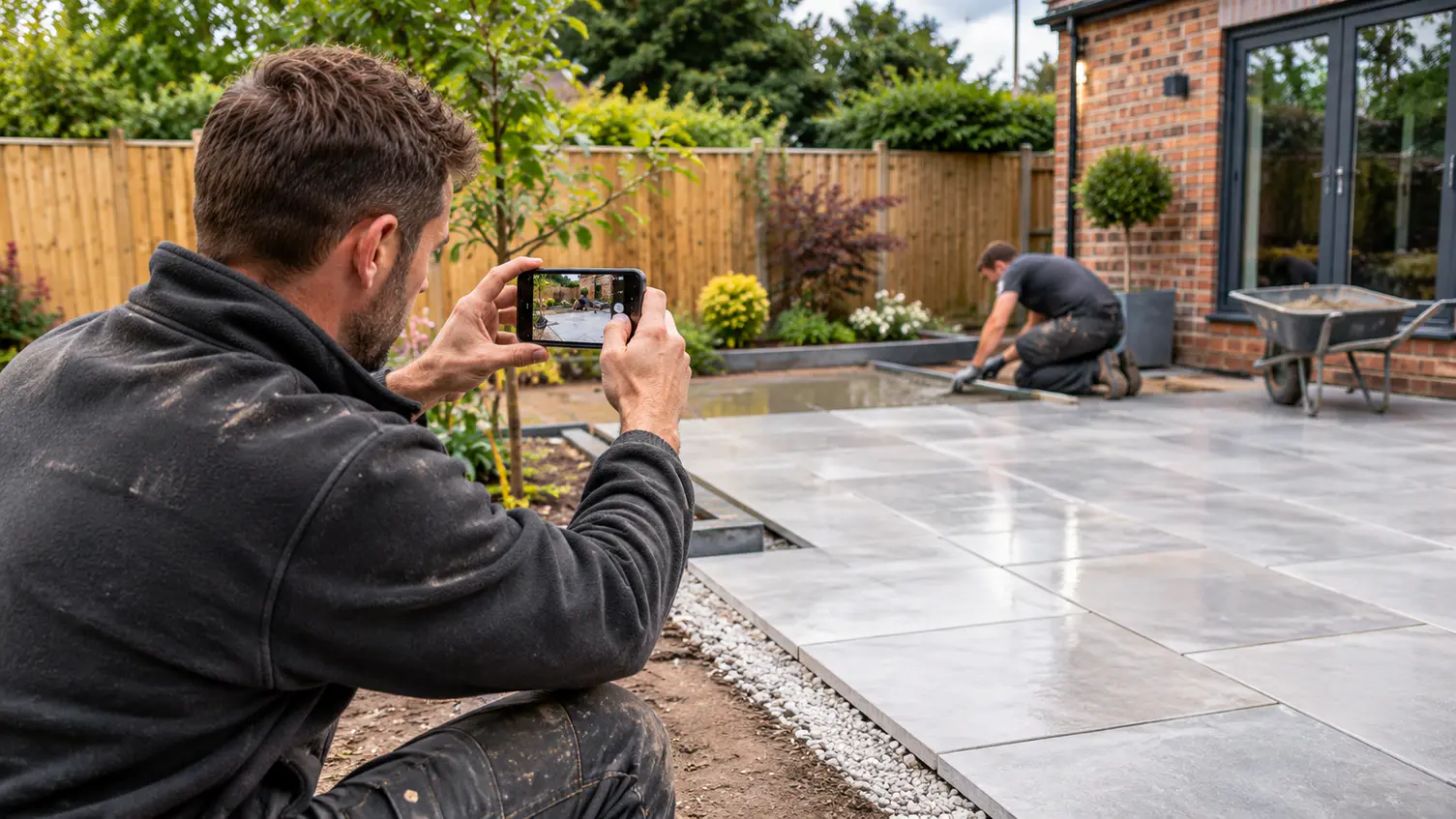
Turn one completed project into several marketing opportunities
Landscaping has an enormous marketing advantage over many other trades.
The work is incredibly visual.
A customer can see an overgrown, unusable garden transformed into a beautifully finished outdoor space.
That's an excellent story to tell.
Yet many landscapers complete a fantastic project, take one photograph of the finished patio, upload it to Facebook and never use it again.
Here's what I'd suggest instead.
For each suitable project, with the customer's permission:
- Photograph the garden before you begin. Show the original condition and the problem the customer wanted to solve.
- Document key stages of the work. Capture the preparation, materials and construction process.
- Photograph the completed result. A clean, well-composed photograph can demonstrate the quality of the finished project.
- Create a website case study. Explain what the customer wanted, how you approached the work and what you delivered.
- Share the project on Google and social media. Use the photographs to reach potential customers who may be considering similar work.
- Ask for an honest review. Give the customer a simple way to share their experience.
Suddenly, one landscaping job has given you several pieces of useful marketing content.
And none of it required you to perform a choreographed dance beside a cement mixer.
Build up your Google reviews
Reviews can help potential customers feel more confident about contacting your business.
After completing a project, send the customer your Google review link and ask whether they'd be happy to leave some honest feedback.
Keep it simple. Something like this:
"Hi, thanks again for choosing us for your garden project. If you're happy to share your experience, we'd really appreciate an honest Google review. It helps other local customers find out about our business."
Google allows businesses to request genuine reviews, but you shouldn't offer discounts, payment or other incentives in exchange for them. Don't selectively request reviews only from customers you expect to leave positive feedback, either.
Read Google's guidance on getting more customer reviews.
And please don't ask your mate Dave to leave a five-star review of a patio installation you haven't actually done.
Genuine customer feedback is much more valuable than a collection of suspiciously enthusiastic reviews from people who have never employed you.
Improve your local SEO
Local SEO is essentially about helping your business become more visible when people search for services in your area.
It doesn't need to involve mysterious algorithms, complicated spreadsheets or somebody promising to get you to number one on Google by Thursday.
Start by making sure your website clearly explains:
- The landscaping services you provide.
- The towns and areas you genuinely cover.
- Your experience and approach.
- Examples of completed work.
- How customers can contact you.
If patios are one of your main services, a dedicated patio installation page can give you more room to explain that service than a single paragraph buried halfway down your homepage.
The same principle applies to fencing, decking and garden transformations.
Add genuinely useful information that answers customer questions. What types of work do you undertake? Which materials do you use? What does the process involve? What should customers consider before requesting a quotation?
Google explains that local visibility is influenced by factors including how closely a business matches the search, its proximity to the searcher and how well established it is. There is no legitimate way to pay Google for a guaranteed higher organic local ranking.
Read Google's guidance on improving your local ranking.
And remember: listing 200 towns at the bottom of your homepage isn't a substitute for building a genuinely useful website.
Days 61–90: Create a repeatable landscaping marketing plan
Once you've established the basics, it's time to start looking at what's working.
By now, you might have received enquiries from Google, a recommendation from a previous customer, a local Facebook post or a leaflet delivered to a neighbouring property.
The question is: which of these activities is producing the right work for your business?
This is where you can start making better decisions about your marketing budget.
Should landscapers pay for leads from Checkatrade or other directories?
Potentially.
Directories and lead generation platforms can help put your business in front of people who are looking for landscaping services.
But the fact that a platform generates enquiries doesn't automatically mean it represents good value for your particular business.
Before signing up, investigate the current costs, contract terms, cancellation arrangements, competition for enquiries and whether potential customers are shared with other businesses.
Then consider your own numbers.
If the platform costs you £200 and generates a profitable £5,000 project, that could be worthwhile.
If it costs you £200, produces fifteen enquiries from people who aren't interested in the services you offer, and takes up several evenings of your life, that's a rather different proposition.
The most important thing is to track what happens after you receive the enquiry.
How many become site visits? How many become quotations? How many become paying customers?
Should you use Google Ads or Facebook Ads?
They can both be useful, but they serve different purposes.
| Marketing channel | What it is good for | What to watch out for |
|---|---|---|
| Google Ads | Reaching people actively searching for landscaping services | Competitive clicks, unsuitable searches and spending without tracking enquiries |
| Facebook and Instagram advertising | Showing visual projects to homeowners in your local area | Paying for attention from people who aren't ready to request a quote |
| Lead generation platforms | Accessing homeowners already looking for tradespeople | Subscription costs, lead quality and competition |
| Local SEO | Building visibility for your services over time | Results take time and are not guaranteed |
| Referrals | Generating trust through existing relationships | Can be inconsistent if they're your only source of work |
For a new business, I'd usually get the website, Google Business Profile and enquiry process working before putting significant money into advertising.
Otherwise, you're essentially paying to send people to a business that isn't quite ready to receive them.
A bit like filling the swimming pool before you've finished building the walls.
If you're ready to test advertising, choose one channel, set a sensible spending limit and decide how you'll measure whether it's working.
With Google Ads, target the services and locations you genuinely want to cover. For Facebook or Instagram, use authentic photographs of your landscaping projects and make it clear how interested homeowners can contact you.
Don't feel you need to advertise on every available platform at once.
Follow up your quotations
Not every marketing problem is actually a marketing problem.
Sometimes a business is receiving plenty of enquiries but isn't turning enough of them into customers.
A homeowner asks for a quotation. You arrange a visit, spend time measuring up, work out the materials, prepare the price and send everything over.
Then nothing.
You might assume they've gone with someone else.
But perhaps they haven't had time to review the quotation. Maybe they have a question about the materials or aren't sure whether waste removal is included.
A friendly follow-up can be useful.
Ask whether they've had a chance to review the quotation and whether there's anything you'd be happy to explain.
You're not trying to pressure someone into buying a patio. You're helping them make an informed decision.
Keep track of your open quotations and their outcomes. It can reveal whether the bigger opportunity is generating more enquiries or improving the way you handle the ones you've already got.
How much should a new landscaping business spend on marketing?
There's no universal marketing budget that works for every landscaper.
A sole trader building up a garden maintenance round has different priorities from a landscaping company employing six people and delivering large residential projects.
The key is to start with an amount you can comfortably afford, understand what each activity costs and review the commercial results.
Here are some illustrative approaches.
| Example monthly budget | Suggested starting approach |
|---|---|
| £50 | A basic professional website where affordable, free Google Business Profile, referrals and organic social media |
| £200 | Website costs, a small local leaflet test, modest promotional spending and contingency |
| £500 | Website, selected local marketing activities and a carefully controlled advertising test |
| £1,000+ | A more structured combination of website development, SEO and paid advertising, provided the business has the capacity and cash flow |
These are example budget levels, not guaranteed advertising costs or recommended spending requirements. Your actual costs will depend on your providers, location, services and marketing objectives.
A new business with limited funds doesn't need to spend every available pound on marketing.
Some of the most useful activities, such as documenting projects, maintaining your Google Business Profile and developing local relationships, can be done without paying for advertising.
They do, of course, require your time.
Which brings us to something rather important.
Measure what actually matters
I've never met a business owner who could pay their staff with Facebook likes.
They're nice. But they're not the objective.
The objective is profitable work.
So, instead of becoming obsessed with social media followers or how many people visited your homepage, start recording the figures that tell you whether your marketing is helping your business.
You can do this in a simple spreadsheet, a notebook or a suitable business management system.
Track:
- How much you've spent on marketing.
- How many enquiries you've received.
- Where those enquiries came from.
- How many were suitable for your business.
- How many quotations you issued.
- How many new customers you won.
- The value and estimated profitability of the work.
A simple example
Imagine two marketing channels produce the following results over the same period.
| Channel A | Channel B | |
|---|---|---|
| Marketing spend | £200 | £200 |
| Enquiries | 10 | 20 |
| New customers won | 2 | 1 |
| Revenue from jobs won | £6,000 | £2,000 |
| Cost per new customer | £100 | £200 |
Illustrative example only. Revenue is not profit, and actual results will vary.
Channel B produced twice as many enquiries. If that's the only thing you're measuring, you might assume it performed much better.
But Channel A generated more customers, more revenue and a lower cost per acquired customer.
You'd also want to consider the profit from the projects, the time spent preparing quotations and whether either channel produces customers who are likely to return.
That's a much better basis for deciding where your next £200 should go.
The idea is to attract work that supports a healthy business, not merely to fill every available space in the diary.
For more on job costs and protecting your margins, read our guide to rising costs and business challenges facing UK landscapers.
Download your free 90-day landscaping marketing checklist
If you've read this far, you've probably got a fairly good idea of what you need to do next.
The difficulty, of course, is finding the time to do it while you're also trying to run a landscaping business.
That's why we've put together a free, printable 90-day marketing checklist specifically for landscapers.
It covers:
- Choosing your priority services and marketing objectives.
- Setting up your Google Business Profile and website.
- Finding your first customers.
- Collecting reviews and creating project case studies.
- Improving local visibility.
- Testing marketing channels and following up quotations.
- Measuring your progress over the first three months.
There's also a monthly marketing scorecard to help you keep track of enquiries, quotations, customers won and marketing spending.
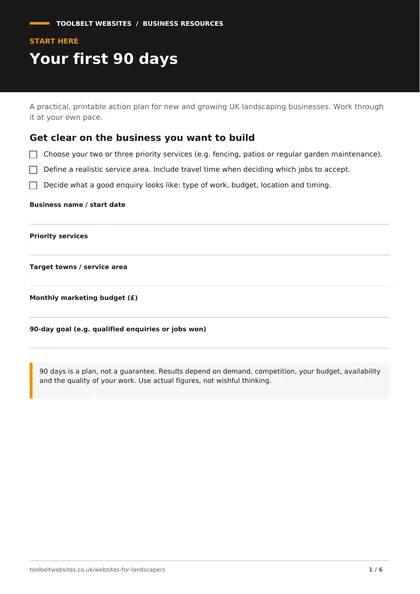
Free business resource
90-Day Landscaping Marketing Checklist
A printable companion to this guide, with actions for each stage of the 90-day plan and a three-month marketing scorecard.
Download the free 90-Day Landscaping Marketing Checklist Open the PDF in your browserNo email address required. No subscription. No invitation to attend a three-hour webinar on how to achieve financial freedom through garden fencing.
Just a practical checklist you can print out, work through and return to whenever you need it.
Frequently asked questions
What is the best way to get landscaping customers when starting out?
Start with personal recommendations, relationships with local trades, a professional website and a correctly configured Google Business Profile. These activities give your business a foundation for finding customers without committing to a large advertising budget.
Do I need a website to start a landscaping business?
A website is not a requirement for starting a landscaping business, but it can help potential customers understand your services, see examples of your work and contact you. It also gives your Google Business Profile, advertising and other marketing channels a central place to direct customers.
How can I market my landscaping business with no money?
Use free channels such as Google Business Profile, relevant local community groups, recommendations from existing contacts and organic social media. Document genuine projects, ask customers for honest reviews and build relationships with complementary local businesses.
How do I get landscaping customers without any reviews?
Communicate your genuine skills and experience, provide professional quotations, show authentic photographs where you have permission and make it easy for customers to verify your business details. As you complete your own projects, request honest reviews from your customers.
Is SEO worth it for landscapers?
SEO can be valuable because customers often search online for landscaping services in their local area. However, results take time and depend on competition, the quality of your website, your business presence and other factors. It is generally best viewed as a longer-term marketing investment.
How long does landscaping marketing take to work?
Some activities, such as referrals and local recommendations, may generate enquiries quite quickly. Others, particularly SEO, may take considerably longer. The 90-day plan in this guide provides a structured way to establish and improve your marketing, rather than promising a specific timeframe for results.
Should I advertise my landscaping business during winter?
It can be worthwhile. Customer demand and the types of work available may change through the seasons, but winter can be a useful time to promote suitable services, prepare case studies, plan spring campaigns and start building a pipeline for the warmer months. Base your spending on actual demand and results.
My final thoughts
Starting a landscaping business is hard work.
There's the physical work, the equipment, the materials, the weather, the quotations, the customers and the endless discovery of things that need replacing on your van.
Marketing can feel like another job on an already rather ambitious list.
But it doesn't have to be complicated.
Start by making it easy for people to find you. Show them what you're good at. Give them a reason to trust your business. Make it straightforward to request a quotation. Then keep track of which activities lead to paying customers.
You don't need to be brilliant at every marketing channel.
You need a handful of things that work for your business, and you need to do them consistently.
At Toolbelt Websites, we want to help tradespeople build businesses that are easier to find, easier to trust and better equipped to attract new work.
For landscapers, that means making sure your online presence reflects the standard of the work you deliver.
Because you've already got enough to do without spending your Sunday evening wondering why nobody can find your business on Google.
Get the foundations right. Work through the checklist. Make the most of every completed project.
And give that phone a reason to ring.
Useful resources
- Google Business Profile — Create or manage your business listing
- Google — Guidelines for representing your business
- Google — Tips to improve your local ranking
- Google — Tips to get more reviews
- Google Search Console
- Information Commissioner's Office — Direct marketing guidance
- Toolbelt Websites — Websites for Landscapers