If your existing website looks dated, is awkward on a phone or no longer reflects the quality of your business, a redesign can be a sensible investment. The difficult part is working out what a fair budget looks like, because the word redesign can mean anything from a visual tidy-up to rebuilding the whole site on a different platform.
We reviewed publicly advertised UK website-redesign pricing in September 2026 to give small businesses a more useful planning range. We found low-hundreds starting prices at the very light end of the market, while complex agency rebuilds can move well into five figures. The right comparison is not the cheapest headline price. It is the amount of work included and the risk involved in changing an existing website.
Pricing research checked: 26 September 2026. Prices can change and VAT treatment is not always stated by suppliers.
How much does it cost to redesign a website in the UK?
For a small UK service business, a sensible starting budget is often somewhere between about £500 and £8,000, depending on whether the job is a light visual refresh or a broader redesign. More complex rebuilds involving large amounts of content, platform migration, booking or payment systems, custom integrations or extensive SEO migration work can reach £5,000–£20,000 or more.
Those figures are not an official UK average. No single authoritative body publishes one. They are practical planning bands based on publicly advertised prices we identified during our September 2026 research. Final quotes vary according to the website you already have and the scope of the work.
| Redesign scope | Typical advertised planning range | What this usually means |
|---|---|---|
| Light visual refresh | £500–£2,500 | Existing structure largely retained; styling, layout and mobile presentation improved. |
| Small brochure-site redesign | £1,000–£5,000 | A small service-business site redesigned with revised layouts, content work and launch support. |
| Larger service-business redesign | £2,500–£8,000 | More pages, stronger restructuring, content migration and more detailed SEO or conversion work. |
| Complex or integration-heavy rebuild | £5,000–£20,000+ | Large sites, platform changes, custom integrations, bookings, payments or significant migration work. |
Important: these are broad advertised market ranges, not quotations. VAT was not consistently stated across the providers reviewed, so always check whether VAT and third-party costs are included in a supplier's figure.
Use the Website Redesign Cost Calculator
The calculator below gives an indicative one-off redesign range based on the scope you select. It uses the market bands identified in our September 2026 research and deliberately returns a range rather than pretending a website can be accurately quoted from six questions.
Your result is a planning estimate, not a quotation. The condition of the existing website, content quality, integrations, migration requirements and supplier pricing can all change the final cost.
Free planning tool
Website Redesign Cost Calculator
Choose the options that best describe your website. No contact details are required and your selections are not sent anywhere.
Your estimate
Complete the questions and select Calculate my estimate.
Estimated one-off redesign cost
£0–£0
This is an indicative market estimate based on the requirements selected. It is not a quotation. The condition of the existing website, content, integrations, migration requirements and supplier pricing can change the final cost.
How we calculated this
What counts as a website redesign?
A redesign does not always mean deleting everything and starting again. It helps to separate three different levels of work.
Visual refresh
A visual refresh keeps most of the existing structure and content but improves typography, spacing, imagery, colours, calls to action and mobile presentation. This can be enough when the website is technically sound and the page structure still makes sense.
Structural redesign
A structural redesign goes further. Pages may be reorganised, navigation simplified, service journeys improved and content rewritten. The underlying platform may stay the same, but the website is reconsidered around how customers actually use it.
Complete redesign and rebuild
A rebuild is appropriate when the existing platform, code, page structure or content creates too many constraints. It may involve a new technical foundation, content migration, new URL planning and more extensive testing. That extra work is why two projects described as a “redesign” can have completely different prices.
Typical website redesign costs in the UK
Our September 2026 research covered more than 15 UK providers publishing current redesign pricing or clear starting prices. The market is extremely wide: some freelancers and small studios advertise light redesigns from a few hundred pounds, while larger agency work commonly starts in the thousands and can exceed £30,000 for more complex projects.
For trades and small service businesses, the useful question is what is included at each level:
- £500–£2,500: usually a smaller or lighter refresh with limited page and functionality changes.
- £1,000–£5,000: often a small brochure or lead-generation website with a more substantial visual and structural redesign.
- £2,500–£8,000: more pages, greater content input, stronger migration requirements or a more involved agency process.
- £5,000–£20,000+: larger sites, platform changes, complex integrations, booking or payment systems, bespoke functionality or substantial migration work.
Do not treat those bands as a price list. A £1,500 quote that includes careful migration and content work may be better value than a £900 quote that excludes them. Equally, a straightforward five-page website does not automatically need a five-figure agency project.
What affects the cost of redesigning a website?
Page count and page types
Ten service pages built from one repeatable layout are different from ten pages that each need a unique structure. Ask how the supplier defines a page, a template and an additional section.
Content rewriting
Reusing strong existing copy keeps the scope down. If every page needs research, restructuring and professional copywriting, the project becomes more substantial.
Photography and media
Good existing photography can be reused. Poor images may need replacing, editing or reshooting. Video, galleries and before-and-after project content also add preparation work.
Forms, bookings, payments and integrations
A normal enquiry form is relatively simple. Booking systems, payment gateways, calculators, CRM connections and other third-party integrations need more setup and testing and may also have separate subscription costs.
Accessibility
Accessibility should be considered as part of the design and build rather than left until the end. The W3C introduction to web accessibility explains why properly designed and coded websites need to work for people with a wide range of abilities and assistive technologies.
Mobile usability and performance
A redesign should improve the experience on the devices customers actually use. Google's Core Web Vitals guidance covers measurable loading, responsiveness and visual-stability signals, while the GOV.UK frontend performance guidance shows why testing performance on realistic devices and connections matters.
Content migration and SEO protection
If existing pages already receive search traffic, migration needs care. Google's site-move guidance recommends mapping old URLs to their new destinations, using permanent redirects where URLs change, updating internal links and canonicals, and submitting the new sitemap. Google also warns that significant site changes can cause temporary ranking fluctuations while pages are recrawled and reindexed.
Privacy and cookies
Forms, analytics, advertising tools and embedded services can affect privacy and cookie requirements. The ICO's small-organisation guidance on privacy notices and cookies is a sensible primary reference when reviewing what the redesigned site collects and explains.
Hosting, maintenance and security
Some quotes stop at launch; others include ongoing hosting, software maintenance, backups and support. The NCSC small-organisations cyber security guide highlights practical areas such as accounts, devices and backups. Ask who is responsible for keeping the website maintained after launch.
Refresh the existing website or rebuild it?
A refresh is usually sensible when the platform is still supported, pages load reliably, the information architecture still makes sense and the main problem is presentation. There is little value in replacing a healthy technical foundation simply to change the typography and hero section.
A rebuild becomes easier to justify when the existing site is difficult to edit, repeatedly breaks, performs poorly on mobile, relies on obsolete software, has accumulated conflicting plugins or workarounds, or cannot support the functionality the business now needs.
The useful question is not “How old is the website?” It is “How much good material and good structure can we safely keep?” Repeatedly paying to patch a fundamentally unsuitable platform can become false economy, but rebuilding a healthy site for fashion alone can waste money and introduce migration risk.
What website redesign costs are commonly overlooked?
- Copywriting: a redesign exposes weak or outdated copy very quickly.
- Image preparation: sourcing, cropping, compressing or commissioning better photography takes time.
- Premium software and integrations: booking tools, payment systems, plugins and external services may have recurring fees.
- Redirect planning: existing URLs need reviewing when the site structure changes.
- Email and DNS work: changing hosting or domain configuration can affect other services if handled carelessly.
- Testing: forms, mobile layouts, browsers, analytics and accessibility checks need time before launch.
- Maintenance and hosting: establish what happens after the initial project is complete.
- VAT: always confirm whether the quoted figure includes or excludes VAT.
Usability is another easily overlooked part of the budget. The GOV.UK guidance on usability benchmarking describes measuring whether people can complete realistic tasks rather than judging a site purely by appearance.
A different option: a managed pay monthly website
Paying several thousand pounds upfront is not the only way to replace an outdated business website.
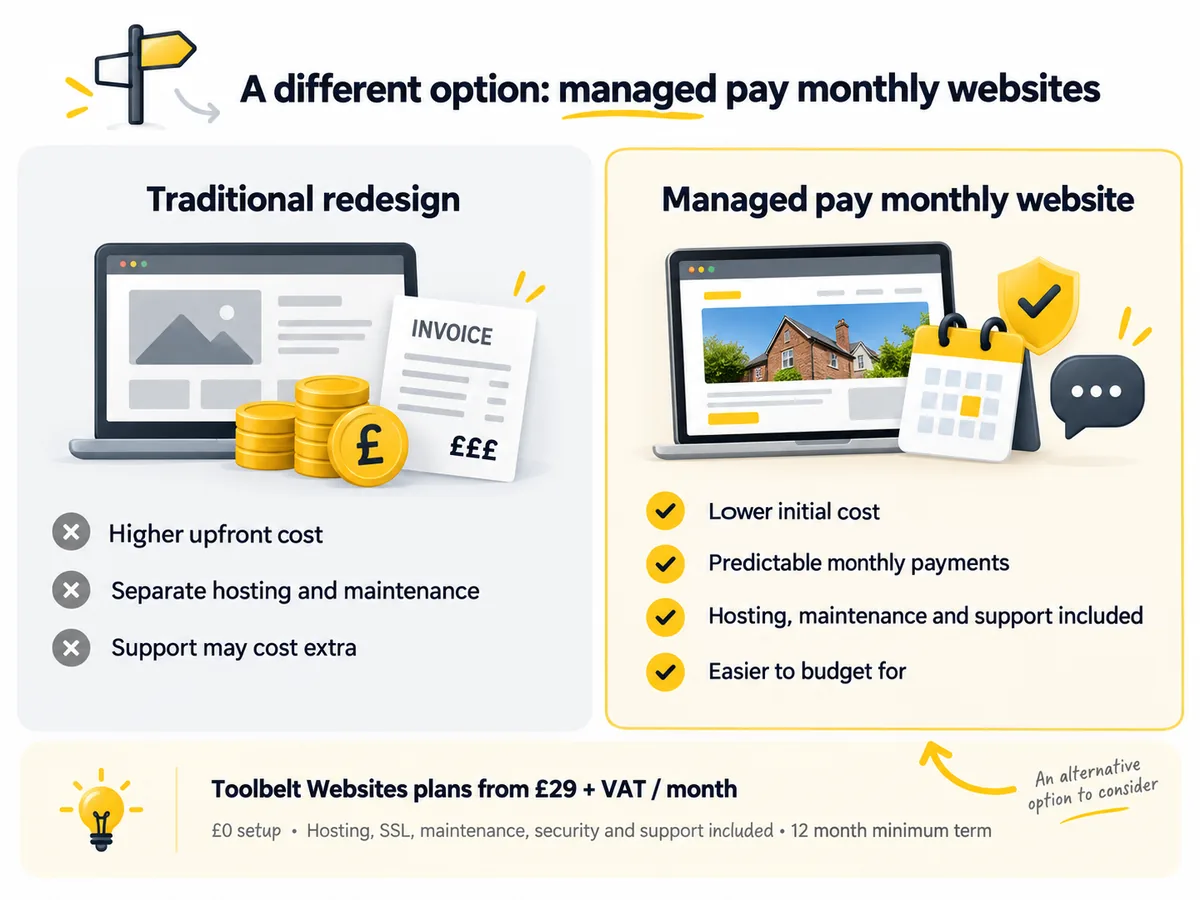
For some businesses, particularly trades and smaller service companies, a managed pay monthly website can be a simpler alternative. Instead of funding the whole build at the beginning, the cost is spread across a predictable monthly payment while the ongoing management of the website is included as part of the service.
That distinction matters because the cost of a traditional website does not necessarily stop when the new site goes live. Hosting, security, software maintenance, updates and support may all become separate ongoing costs. With a managed website service, those elements can be bundled together.
How Toolbelt Websites approaches managed pay monthly websites
Toolbelt Websites currently offers managed website plans from £29 + VAT per month, with £0 setup fee. A 12 month minimum term applies.
Depending on the plan, the monthly service includes the website itself together with:
- hosting and SSL;
- routine maintenance and security;
- ongoing support;
- an allowance for website changes;
- professional design and SEO foundations appropriate to the package.
For a business that would rather avoid a large upfront website bill, this can make the cost easier to budget for while also removing much of the ongoing technical management.
See managed pay monthly website plans →
Upfront redesign or pay monthly?
Neither commercial model is automatically the right answer for every business. A one-off project may suit a company that wants to fund the work upfront and then manage its own hosting, maintenance and future development. A managed pay monthly website may make more sense when the priority is reducing the initial cost and having hosting, maintenance, security and support handled as part of one ongoing service.
| Question | One-off redesign | Managed pay monthly website |
|---|---|---|
| Initial outlay | Usually higher upfront project cost. | Usually lower upfront cost with recurring monthly payments. |
| Ongoing hosting and maintenance | May be separate or optional. | Can be included in the monthly service. |
| Support | Often limited to a launch period unless a care plan is added. | Ongoing support can form part of the subscription. |
| Minimum term | Normally governed by project payment terms. | Check the minimum contractual term and cancellation rules. |
| Ownership and licences | Check exactly what code, design, software and third-party licences are transferred. | Check what you own, what remains proprietary and what happens if you leave. |
| Best comparison | Compare the full cost and included services over the same period, not just the first invoice. | |
Toolbelt Websites also offers a separate one-off Website Renovation service from £1,499 for businesses that already have a website and want a substantial professional redesign. That route and the managed monthly plans solve different problems, so compare the scope, ongoing commitments and what happens after launch rather than assuming either option is automatically cheaper.
How to compare website redesign quotations
Put each quotation side by side and check the scope rather than jumping to the smallest total. Ask:
- How many pages and unique layouts are included?
- Is copywriting included, edited or simply migrated unchanged?
- Are images supplied, prepared and optimised?
- Which forms, bookings, payments or integrations are included?
- What happens to existing URLs and pages that already rank?
- Who creates and tests redirects if URLs change?
- Are analytics, forms and cookie/privacy requirements checked?
- Is mobile and performance testing included?
- What revision allowance is included?
- Who handles launch, DNS and any hosting changes?
- What support is included after launch, and for how long?
- Which third-party costs are excluded?
- Is the price inclusive or exclusive of VAT?
- What do you own at the end of the project?
A useful quote should make the boundaries clear enough that you can understand why it costs what it costs. If two quotes are thousands of pounds apart, compare what has actually been scoped before deciding one supplier is expensive or the other is a bargain.
Frequently asked questions
How long does a website redesign take?
A small redesign can take a few weeks once content and decisions are available. Larger rebuilds can take several months where there are many pages, stakeholders, integrations or migration requirements. The supplier should explain what depends on you and what depends on them.
Can I keep my existing domain and email?
Usually, yes. Redesigning the website does not normally require changing the domain name, and email can often remain exactly where it is. If DNS or hosting needs to change, confirm how existing email is configured before anybody edits the domain records.
Will a redesign affect my Google rankings?
It can. Changes to URLs, content, internal links, page speed and indexability can affect search visibility. A careful redesign should review the pages that already receive traffic, preserve useful URLs where practical, map changed URLs with redirects and monitor the site after launch. Google notes that temporary ranking fluctuations can occur during significant site moves.
Can I reuse my existing text and photographs?
Yes, where they are still accurate and good enough. Strong existing copy and genuine high-quality project photography are valuable assets. A redesign is also a good time to remove outdated information and replace images or text that no longer represent the business.
Is a pay-monthly website cheaper than paying upfront?
Not necessarily. It may reduce the initial outlay, but you should compare the full minimum-term cost and what is included. A managed monthly plan may include hosting, maintenance, security and support that would otherwise be separate. A one-off project may have a larger initial cost but different ongoing commitments.
How often should a business website be redesigned?
There is no sensible fixed schedule. Redesign when the website is creating a business problem: it no longer represents the company, customers struggle to use it, the platform is difficult to maintain, key functionality is missing, or technical limitations are holding back improvements. A website that still works well does not need replacing simply because it reached a particular birthday.
Plan the scope before judging the price
Website redesign prices make more sense once you separate a light refresh from a structural rebuild. Start with what is wrong, what needs to be kept and what the finished website needs to do. Then compare quotations on the same scope.
The calculator can give you a useful planning range, but the next step should be a proper review of the existing site before anyone promises a final figure.