
What Should a Plumber's Website Include? 15 Things That Help Turn Visitors Into Enquiries
A practical framework for UK plumbers and heating engineers who want a website that helps urgent and planned customers take the right next step.

A useful plumber website should quickly tell customers what work you do, where you work, why they can trust you and how to contact you. It should make urgent calls easy while giving customers planning larger jobs enough information to compare your services, previous work and reputation.
The strongest plumbing websites are not necessarily the ones with the most pages or visual effects. They are the ones that make the next step obvious for the type of customer who has arrived.
That matters because a plumbing website can serve two very different visitors.
Someone with water coming through a ceiling may want to know three things immediately: do you deal with this problem, do you cover my area, and can I call you now?
Someone planning a boiler replacement, bathroom project or heating upgrade may behave very differently. They may want to see previous work, understand your services, check relevant qualifications, read reviews and find out what happens after they request a quote.
A good website should accommodate both journeys without pretending every plumbing business offers emergency work.
The 15 essentials at a glance
- A homepage that immediately says what you do and where
- A phone number that is genuinely easy to use
- Different routes for urgent work and planned projects
- Proper pages for the plumbing services you actually want
- Genuine photographs that prove the work is real
- Relevant qualifications and Gas Safe evidence
- Real reviews and trust evidence
- Clear and genuine service areas
- An enquiry form that asks useful questions without becoming an obstacle
- An About section that helps customers know who they are contacting
- Clear calls to action throughout the customer journey
- A mobile experience designed around real use
- Fast pages and properly prepared imagery
- Answers to the questions customers ask before contacting you
- SEO foundations that customers rarely see
1. A homepage that immediately says what you do and where
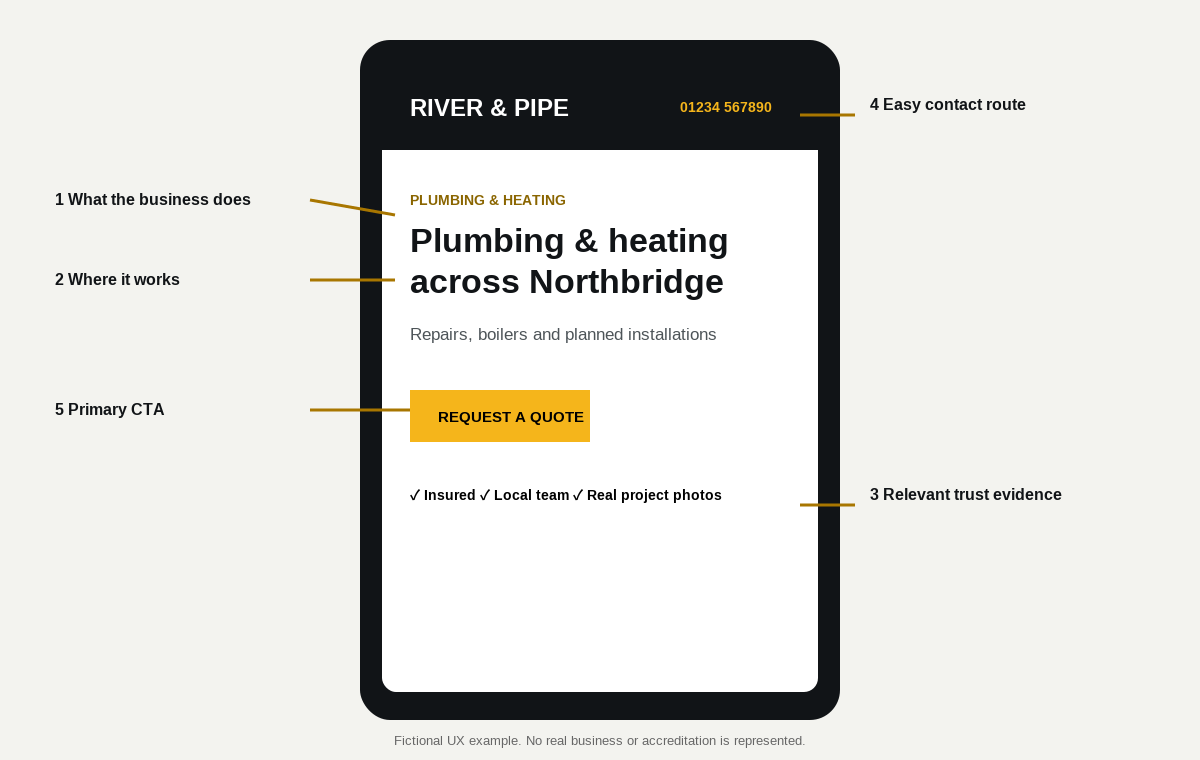
The first screen should do useful work. A visitor should not have to read several paragraphs before understanding that you are a plumbing or heating business, which area you genuinely cover and what they can do next.
A strong opening normally establishes the main service, the primary operating area, a useful reason to consider the business, a clear contact route and relevant trust evidence.
That does not mean squeezing every accreditation, service and town into the hero section. It means prioritising the information that helps a new visitor decide whether they are in the right place.
Compare that with a heading such as “Welcome to our website.” It uses the most prominent space on the page without answering a customer question.
If you cover Ipswich and surrounding parts of Suffolk, say that clearly. If your work is focused on boiler installation and heating rather than general emergency plumbing, make that clear too.
The homepage should orient the visitor. The deeper pages can provide the detail.
2. A phone number that is genuinely easy to use
For some plumbing enquiries, calling is the most practical next step.
A phone number should therefore be visible, readable and tappable on mobile. An urgent visitor should not have to open a contact page, copy a number and paste it into the phone app.
A clear header contact route or a well designed mobile action can help, provided it does not cover content or become irritating.
The important word here is appropriate. A phone call is not automatically the best action for every visitor. Someone planning a bathroom project may prefer to send details and photographs so you can understand the job before speaking. A landlord asking about planned work may want a quote request rather than an immediate call.
The website should make calling easy without forcing every customer into the same route.
3. Different routes for urgent work and planned projects
This is one of the most useful distinctions a plumbing website can make.
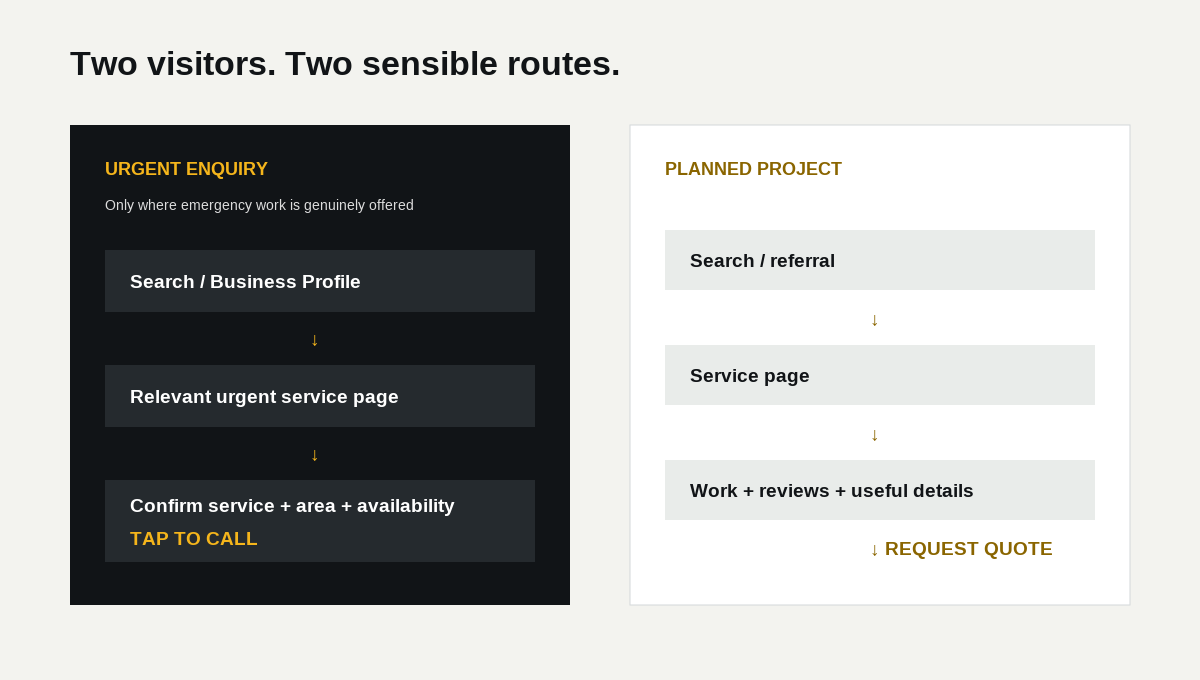
An urgent customer may arrive from Search or a Business Profile, land on an emergency plumbing page, confirm that you cover the problem and area, check genuine availability and tap to call.
A planned work customer may arrive through search, a recommendation or an advert, read a service page, inspect completed work, check reviews, understand the process and then request a quote.
Those are different journeys with different information needs.
For urgent work, excessive friction is a problem. The customer may need a quick answer and a direct contact route.
For planned work, too little information can be the problem. A customer considering a larger job may reasonably want evidence before inviting someone into their home or requesting a quotation.
If you do not provide emergency plumbing, do not manufacture an emergency journey because competitors do. Do not advertise 24/7 availability, same day response times or emergency callouts unless you genuinely provide them.
A useful website reflects how the business actually works.
4. Proper pages for the plumbing services you actually want
A single list containing “boilers, bathrooms, leaks, heating, radiators, repairs” tells a customer very little.
Important services usually deserve enough information for someone to understand what you do, whether their job is relevant and what they should do next.
Depending on the business, that might mean useful pages for boiler installation, boiler servicing, leak detection and repairs, bathroom plumbing, heating systems, radiators, power flushing, landlord gas safety work or underfloor heating.
That is not an instruction to create a page for every small task.
Prioritise services that matter commercially and that customers genuinely need information about. A focused service page can explain the work, show relevant evidence, answer common questions and provide the right enquiry route.
There is an SEO benefit too: a focused page gives search engines clearer page level context than one vague page trying to represent every service. But separate pages do not guarantee rankings, and more pages are not automatically better.
The customer value comes first.
5. Genuine photographs that prove the work is real
Plumbing and heating businesses have an advantage that many service companies overlook: the work can often be shown.
Useful photographs might include completed bathrooms, boiler installations, pipework, heating projects, before and after comparisons, the team, branded vans or appropriate working environments.
Strong real photography provides evidence that the business exists and carries out the type of work being described.
That does not mean every phone photograph belongs on the website. Dark, blurry or badly framed images can weaken an otherwise professional page. Select and prepare the strongest material.
Where genuine photography is not available, good licensed stock imagery can still support a design, but it should be used honestly. A stock photograph should never be presented as a job completed by the business.
For a fuller comparison, see Toolbelt Websites' guide to stock photographs versus your own images.
6. Relevant qualifications and Gas Safe evidence
Trust badges only help when they are accurate and relevant.
Gas Safe registration is a good example because the wording matters. Being a plumber does not automatically mean every job involves gas.
Where a business undertakes gas work, customers should be able to verify the relevant Gas Safe credentials. The Gas Safe Register states that gas businesses and engineers carrying out gas work within scope must be registered and appropriately qualified for the work they undertake.
If that applies to your business, show the information accurately and give customers a sensible way to verify it.
Other qualifications, memberships, insurance details or accreditations can also be useful where they are genuine, current and relevant to the service being sold.
Do not add badges because they look reassuring. Do not invent registration numbers. Do not leave expired memberships on the website.
Trust evidence works because it can be believed.
7. Real reviews and trust evidence
A testimonial section should help a customer judge the business, not simply fill space.
Use genuine reviews and make it clear where they come from. Recent reviews can show that the business is active. Reviews relating to the service a customer is considering can be particularly useful.
Trust evidence can go beyond reviews. Completed projects, genuine years in business, relevant qualifications, photographs, warranties that are actually offered and a clear explanation of how the company works can all reduce uncertainty.
Placement matters too. A customer reading a boiler installation page may benefit from relevant evidence close to the point where they are deciding whether to request a quote.
Do not fabricate ratings, review counts or customer comments. And do not assume that embedding reviews on a website is an SEO shortcut. Their main job on the page is to help a real visitor assess the business.
8. Clear and genuine service areas
A customer needs to know whether you actually travel to their property.
State the primary operating area clearly and describe surrounding coverage accurately. If particular towns or districts are important enough to need their own content, those pages should contain useful information rather than the same paragraph with a place name swapped.
Google treats plumbers as a standard example of a service area business. Its Business Profile guidance says businesses that travel to customers and do not serve customers at their own address should remove that address from the profile and define their genuine service areas.
That does not mean a website should generate dozens of near identical town pages.
A location page is useful when the business genuinely serves the area and the page can help someone in that location. If the only difference is the town name, rethink it.
We cover this in more detail in why copy and paste location pages can create SEO problems.
9. An enquiry form that asks useful questions without becoming an obstacle
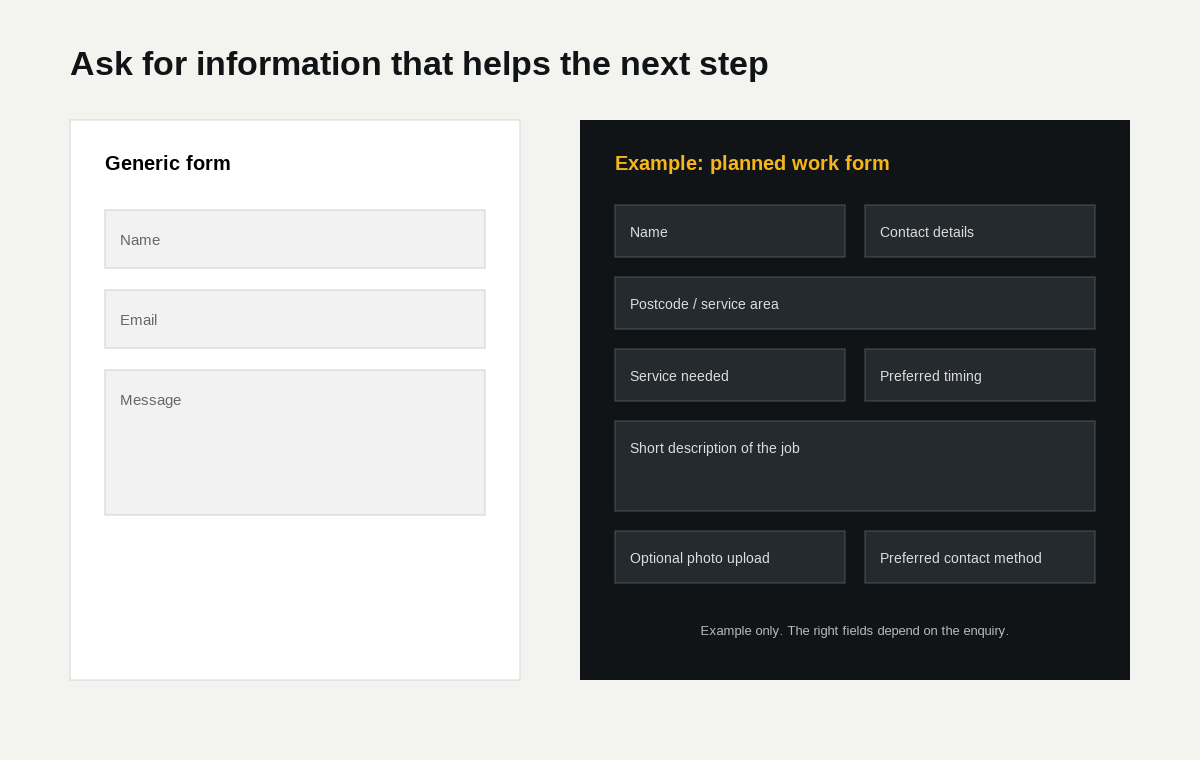
There is no universal rule that every form should contain the fewest possible fields. The right amount of information depends on the enquiry.
For planned work, asking for a postcode, the service required, preferred timing, a short description and an optional photograph can help you understand the job before calling back. Asking how the customer prefers to be contacted can also be useful.
For an urgent visitor, making them complete a long form may be completely wrong. A direct phone route may be more appropriate.
The goal is to collect enough information to make the next step useful without turning the form into an application process.
Only collect information you genuinely need. Make labels clear. Explain optional fields. Test the form on a phone. Make sure successful submissions are obvious and that enquiries actually reach the correct inbox.
A form that looks polished but silently fails is worse than a basic form that works.
10. An About section that helps customers know who they are contacting
A plumber is often invited into someone's home. An anonymous website can therefore create unnecessary uncertainty.
A useful About section can explain who runs the business, who customers may meet, how long the company has operated, what it specialises in and where it works. Real photographs can help where appropriate.
This does not need to become a corporate history lesson. Customers usually care more about who they are dealing with and whether the business looks credible than a generic mission statement about “excellence and customer satisfaction”.
Use the About page to make the company more understandable.
11. Clear calls to action throughout the customer journey
Not every button needs to say Contact us.
The action should fit the visitor and the page. Useful examples include Call now, Request a quote, Ask about this service, Send photos of the job and Check availability.
An emergency plumbing page may reasonably prioritise calling. A bathroom installation page may prioritise a quote request. A detailed service page may offer both.
Calls to action should appear where they make sense rather than being repeated after every paragraph.
The principle is simple: once a visitor has enough information to act, do not make them search for the next step.
12. A mobile experience designed around real use
A plumbing website has to work properly on a phone.
That means readable text, controls that are easy to tap, sensible navigation, forms that fit the screen, working phone links and images that do not make the page unnecessarily heavy.
Sticky call or quote actions can be useful, particularly on service pages, but they should not cover important content or make the interface feel cramped.
Test the actual journey rather than only shrinking a desktop browser window.
Can a customer open the menu with one hand? Can they tap the phone number? Can they complete the quote form without zooming? Does an image push the important information too far down the page? Does the cookie banner cover the main action?
Mobile design is not a separate decoration layer. It is part of whether the website works.
13. Fast pages and properly prepared imagery
A visually strong plumbing website does not need to be bloated.
Common problems include uploading enormous photographs straight from a phone or camera, loading scripts that add little value, autoplaying large videos and using visual effects that make the page heavier without helping the customer.
Images should be resized for their intended use, compressed sensibly and served in appropriate formats. Responsive image handling can prevent a small phone from downloading an unnecessarily large desktop image.
Toolbelt Websites has a separate guide explaining why image format matters on a website.
Google recommends good Core Web Vitals as part of a strong overall page experience, but a particular performance score does not guarantee rankings. Treat performance as a user experience and technical quality issue, not a magic SEO number.
14. Answers to the questions customers ask before contacting you
Useful website content often comes directly from the questions customers already ask.
That might include:
- Which areas do you cover?
- Do you offer emergency callouts?
- Is there a callout charge?
- Which types of work do you take on?
- Are quotations free?
- Should I send photographs before you visit?
- What payment methods do you accept?
- Do you provide a warranty or guarantee?
- Is there anything I should do before you arrive?
The correct answers depend on the business. Do not copy another plumber's policies.
Publishing accurate answers can reduce uncertainty and help filter unsuitable enquiries before they take up time.
These answers do not all need to live inside one enormous FAQ accordion. Put important information close to the service or action it relates to.
15. SEO foundations that customers rarely see
Some of the most important website work is barely visible to a customer.
Each important page should have a descriptive title, a sensible heading structure, crawlable text, useful internal links and a clean URL. The site should be indexable, served securely over HTTPS and supported by an accurate sitemap.
Google Search Console can help monitor indexing and search performance. A correctly configured Google Business Profile can support the local presence around the website.
Structured data can give search engines explicit information about a page or business. Schema.org includes a Plumber type, and Google recommends using the most specific relevant LocalBusiness subtype where appropriate.
Structured data is not a ranking shortcut and does not guarantee a particular search appearance.
SEO foundations are exactly that: foundations. They make it easier for search engines to access and understand the site, but they cannot guarantee where a page will rank.
How many of these does your plumbing website already have?
This is a practical self check, not a ranking or conversion guarantee. Tick what is genuinely in place.
Toolbelt Websites builds managed websites specifically for UK tradespeople, including plumbers.
See websites for plumbersFrequently asked questions
What pages should a plumber website have?
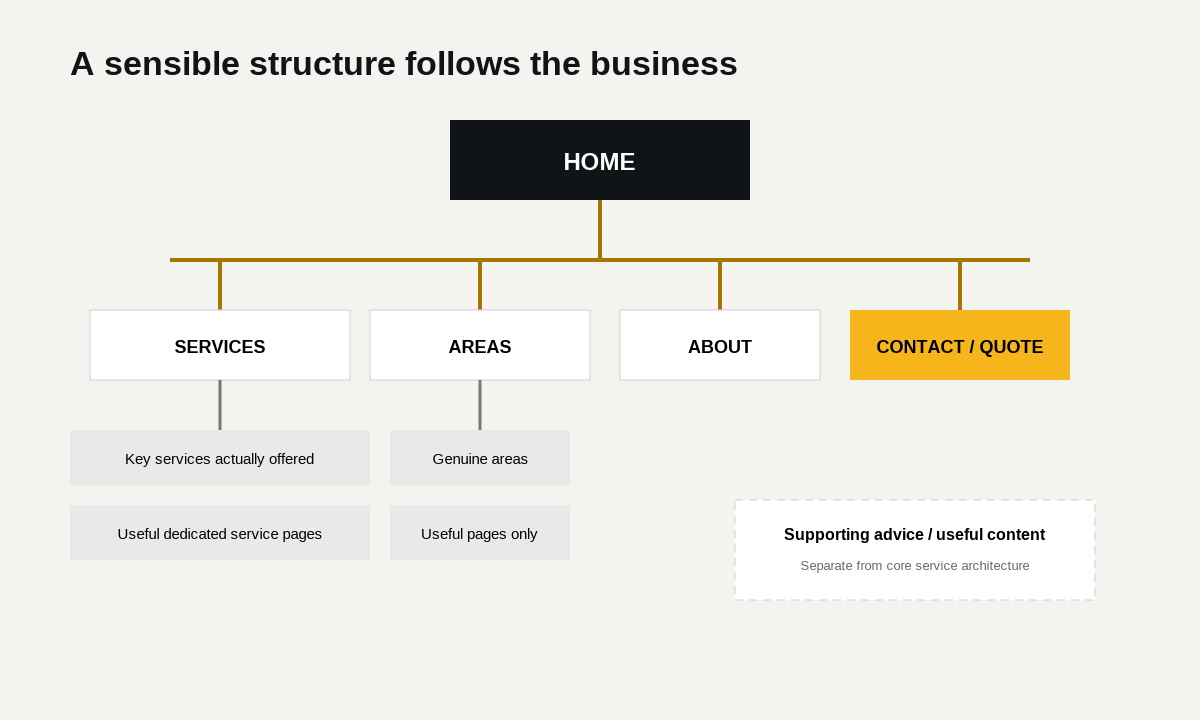
There is no correct page count for every plumbing business. A typical site may include Home, About and Contact pages plus useful pages for the most important services and genuine service areas. The structure should follow the work the business actually provides rather than an arbitrary target.
Does every plumbing service need its own page?
No. Prioritise services that are commercially important and deserve useful dedicated information. Creating thin pages for every minor task can make the site harder to manage without adding much value.
Should a plumber show prices on the website?
It depends on how predictable the work is. Some businesses can publish fixed prices, callout charges or starting prices. Other jobs need to be assessed first. Even when an exact figure is not possible, explaining how pricing or quotations work can reduce uncertainty. See our guide on whether you should show prices on your website.
Does a plumber need a Google Business Profile as well as a website?
They do different jobs. A Business Profile can show business information in Google Search and Maps, while a website gives you more space to explain services, show evidence and build suitable enquiry journeys. For many local plumbing businesses they are complementary rather than interchangeable.
Should plumbers use location pages?
Only where the business genuinely serves the location and the page can be useful. Avoid mass producing near identical pages with the town name changed.
Should a plumber put a Gas Safe badge on the website?
Only where the business or relevant engineers are genuinely registered and the information is accurate. Gas Safe registration relates to gas work. It is not a blanket requirement for all plumbing work.
A good plumbing website makes the next step easier
A strong plumber website is not defined by how many animations, pages or features it contains.
It should make the business easy to understand, easy to trust and easy to contact, while giving each important service enough information to stand on its own.
That means designing around real customer journeys rather than a generic website checklist.
If you are planning a new site, Toolbelt Websites builds professionally managed websites for plumbers with clear service pages, mobile contact routes, SEO foundations, hosting and ongoing support included.
Still need help?
If you are a customer then email Toolbelt Websites support and we will point you in the right direction.
Email support